
Genesis 6 is often counted among the darkest chapters in the Bible. It is the chapter where God grieves that He made man, and announces that He will judge the whole earth with a flood. And yet, astonishingly, this very chapter is where Scripture speaks two words for the first time: “grace” (Genesis 6:8) and “covenant” (Genesis 6:18). The two gospel words that run through the whole Bible were born in the very middle of a declaration of judgment. In this Genesis 6 exposition we will walk through the text and read together the story of a world full of wickedness — and the great turning point, “But Noah.”
The English Scripture quotations here are from the King James Version and the World English Bible (both public domain).
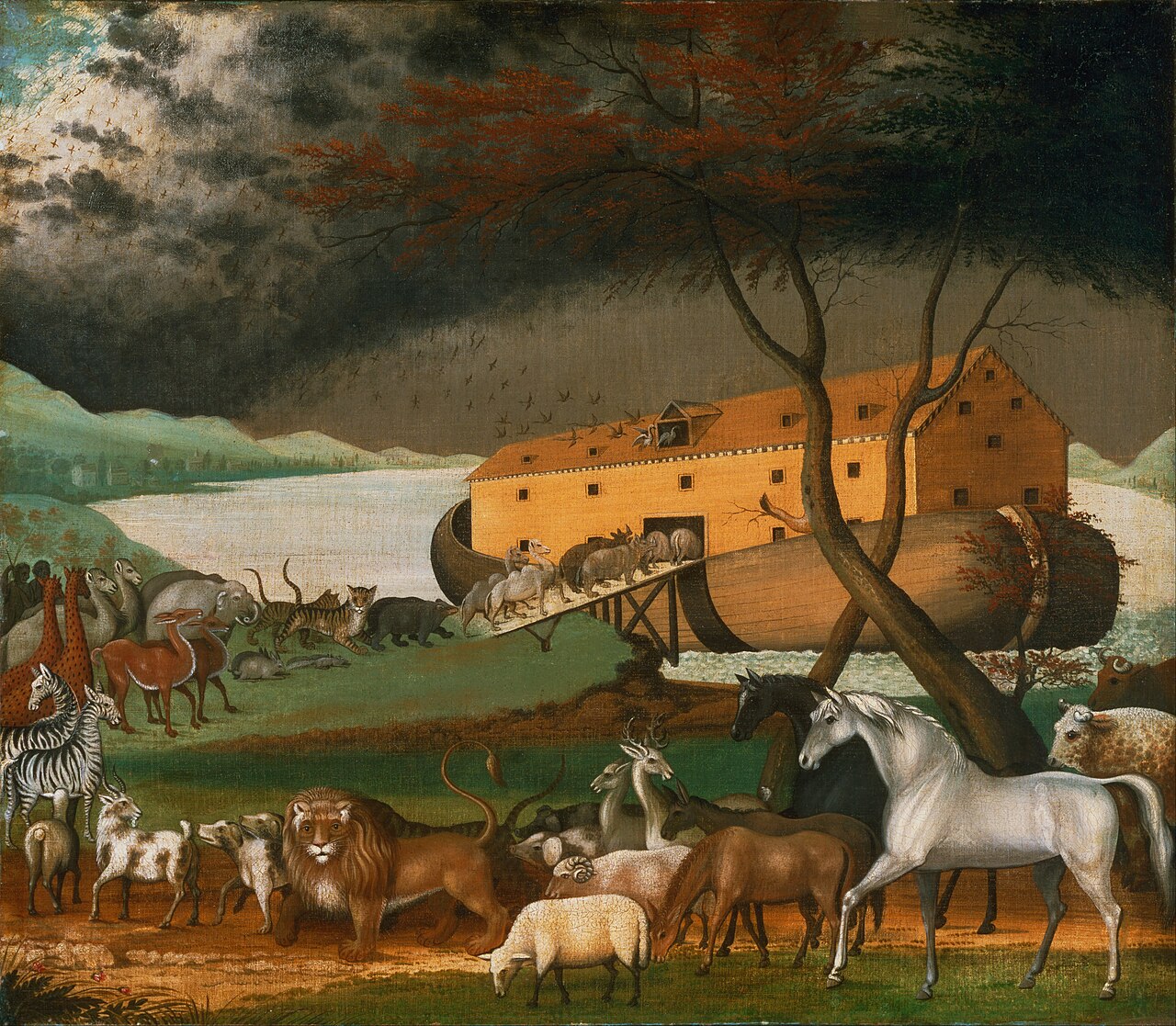
Painting: Edward Hicks, Noah’s Ark · Public domain · Wikimedia Commons
From the Genealogy of Death to the Story of the Flood — “The Generations of Noah”
Genesis 6 continues in one breath from the previous chapter. The genealogy of chapter 5 passed through eight tollings of “and he died,” ending with Lamech naming his son Noah in hope of comfort (Genesis 5:29) and Noah fathering Shem, Ham, and Japheth (Genesis 5:32). The first part of chapter 6 (verses 1-8) shows the end of that genealogy’s era — how far humanity had fallen — and at verse 9 a new section opens.
“This is the history of the generations of Noah: Noah was a righteous man, blameless among the people of his time. Noah walked with God.”— Genesis 6:9 (WEB)
The phrase rendered “the history of the generations” is the Hebrew toledot (generations, account), a literary marker that weaves the whole of Genesis into ten sections. Following “the history of the generations of the heavens and of the earth” (Genesis 2:4) and the genealogy of Adam (Genesis 5:1), Genesis 6:9 is the third such heading, opening the door to the story of Noah that runs to the end of chapter 9. Where the genealogy of death ends, Scripture now begins the story of judgment and salvation.
The Sons of God and the Daughters of Men (6:1-4) — A Boundary Broken Down
Scripture reads the corruption of Noah’s generation beginning with a marriage custom.
“When men began to multiply on the surface of the ground, and daughters were born to them, God’s sons saw that men’s daughters were beautiful, and they took any that they wanted for themselves as wives.”— Genesis 6:1-2 (WEB)
Who “the sons of God” were has been debated in many directions, but Scripture answers from Scripture: “For as many as are led by the Spirit of God, they are the sons of God” (Romans 8:14, KJV). In the Bible’s own usage, a son of God is not a matter of bloodline or rank but a person led by the Spirit of God. The context points the same way. Chapters 4-5 have been contrasting the line of Cain with the line of Seth, and it was in Seth’s line that “men began to call on Yahweh’s name” (Genesis 4:26). The sons of God, then, are the worshiping line — those who called on Yahweh’s name and were to live under His leading — and the text indicts that line for mingling with the daughters of men and losing its distinctness. On this reading the words of the very next verse, “My Spirit will not strive with man forever” (Genesis 6:3, WEB), fall naturally into place as a declaration against a generation that had abandoned the Spirit’s leading.
What the text emphasizes is plain. They “saw… and took any that they wanted.” The wording echoes Eden, where the woman saw that the tree was “good for food, and that it was a delight to the eyes” (Genesis 3:6) and took. Ignoring the distinctions and boundaries God has set and taking whatever looks good in one’s own eyes — that is the grammar of the fall. The note that the Nephilim were on the earth in those days belongs to this same context. The word Nephilim appears only here and in Numbers 13:33, and the text introduces them simply as “the mighty men who were of old, men of renown” (Genesis 6:4). That generation admired its famous mighty men — but God was looking at it with entirely different eyes.
Then God declares a time limit.
“Yahweh said, ‘My Spirit will not strive with man forever, because he also is flesh; so his days will be one hundred twenty years.'”— Genesis 6:3 (WEB)
Many interpreters have read these 120 years as a period of reprieve before the flood. Just as Peter testifies — “when God waited patiently in the days of Noah, while the ship was being built” (1 Peter 3:20) — even the deadline of judgment was, in truth, a season of long patience.
The Wickedness of Man Was Great in the Earth (6:5-7) — The Grief of God
“Yahweh saw that the wickedness of man was great in the earth, and that every imagination of the thoughts of man’s heart was continually only evil. Yahweh was sorry that he had made man on the earth, and it grieved him in his heart.”— Genesis 6:5-6 (WEB)
In Genesis 1, God looked seven times at what He had made and pronounced it good (Genesis 1:4, 10, 12, 18, 21, 25, 31). Now the same God looks — and grieves. The language of the text is relentless: “every imagination,” “continually,” “only evil.” Sin is not the problem of a few violent criminals; it has taken root in the thoughts of the heart. It is exactly as Paul, quoting the Psalms, affirms in the New Testament.
“As it is written, ‘There is no one righteous; no, not one. There is no one who understands. There is no one who seeks after God. They have all turned away. They have together become unprofitable. There is no one who does good, no, not so much as one.'”— Romans 3:10-12 (WEB)
How, then, should we read the statement that God “was sorry”? Elsewhere Scripture says plainly, “God is not a man, that he should lie, nor a son of man, that he should repent” (Numbers 23:19). Strikingly, 1 Samuel 15 places side by side, within a single chapter, “It grieves me that I have set up Saul to be king” (1 Samuel 15:11) and “the Strength of Israel will not lie nor repent; for he is not a man, that he should repent” (1 Samuel 15:29). Scripture itself sets the two statements together without contradiction. The key is in “he is not a man.” God’s “sorrow” (Hebrew nacham) is not a human regret admitting a mistaken plan; it is God’s personal grief and pain over sin, expressed in human language. The God of Genesis 6 is no cold judge; He is the God who is “grieved in his heart” over the people He made.
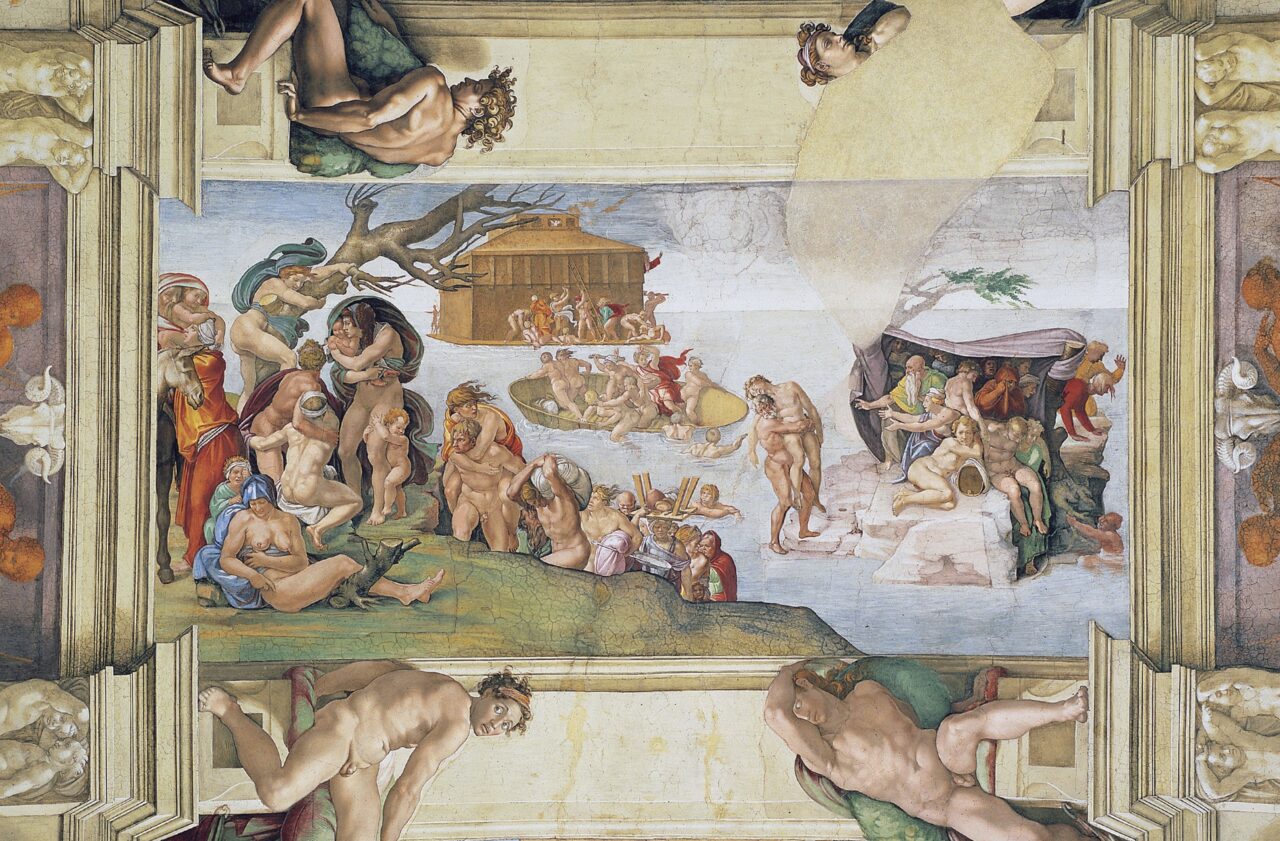
Painting: Michelangelo, The Deluge · Public domain · Wikimedia Commons
“But Noah” (6:8-10) — The First “Grace” in the Bible
Right after the declaration of destruction in verse 7 comes one sentence that changes the course of the whole Bible.
“But Noah found grace in the eyes of the LORD.”— Genesis 6:8 (KJV)
This verse is the first appearance of the Hebrew word chen (“grace”) in the Bible. That the first occurrence of a word used sixty-nine times in the Old Testament falls in the verse immediately after a declaration of judgment is no coincidence. Grace always shines brightest under the shadow of judgment. The order matters, too. Verse 8 first says Noah “found grace,” and only then does verse 9 say “Noah was a righteous man.” Noah did not earn grace by being righteous; because he was a man who had received grace, he could live as a righteous man in a corrupt world, a man who “walked with God” (cf. Ephesians 2:8). That “walking” was also the path of his great-grandfather Enoch (Genesis 5:24). The walk that broke the genealogy of death now continues through Noah in the middle of a generation under judgment.
The book of Hebrews interprets Noah’s life in the language of faith.
“By faith, Noah, being warned about things not yet seen, moved with godly fear, prepared a ship for the saving of his house, through which he condemned the world, and became heir of the righteousness which is according to faith.”— Hebrews 11:7 (WEB)
A Corrupt Earth, Filled with Violence (6:11-13)
“The earth was corrupt before God, and the earth was filled with violence. God saw the earth, and saw that it was corrupt, for all flesh had corrupted their way on the earth.”— Genesis 6:11-12 (WEB)
In two short verses the word “corrupt” sounds three times. The world God had pronounced “very good” (Genesis 1:31) had rotted from within, and that corruption filled the earth as “violence” — power crushing the weak. Note the phrase “before God” (Genesis 6:11). In human eyes that age may have looked like an era of prosperity in which mighty men made their names, but the standard of judgment is always before God. God says to Noah, “I will bring an end to all flesh, for the earth is filled with violence through them” (Genesis 6:13). Judgment was no whim; it was the just decision rendered after long watching and long patience.
“Make a Ship of Gopher Wood” (6:14-16) — The Blueprint of Salvation
The God who declared judgment opens the way of salvation in the same breath: the command to build the ark.
“Make a ship of gopher wood. You shall make rooms in the ship, and shall seal it inside and outside with pitch. This is how you shall make it. The length of the ship shall be three hundred cubits, its width fifty cubits, and its height thirty cubits. You shall make a roof in the ship, and you shall finish it to a cubit upward. You shall set the door of the ship in its side. You shall make it with lower, second, and third levels.”— Genesis 6:14-16 (WEB)
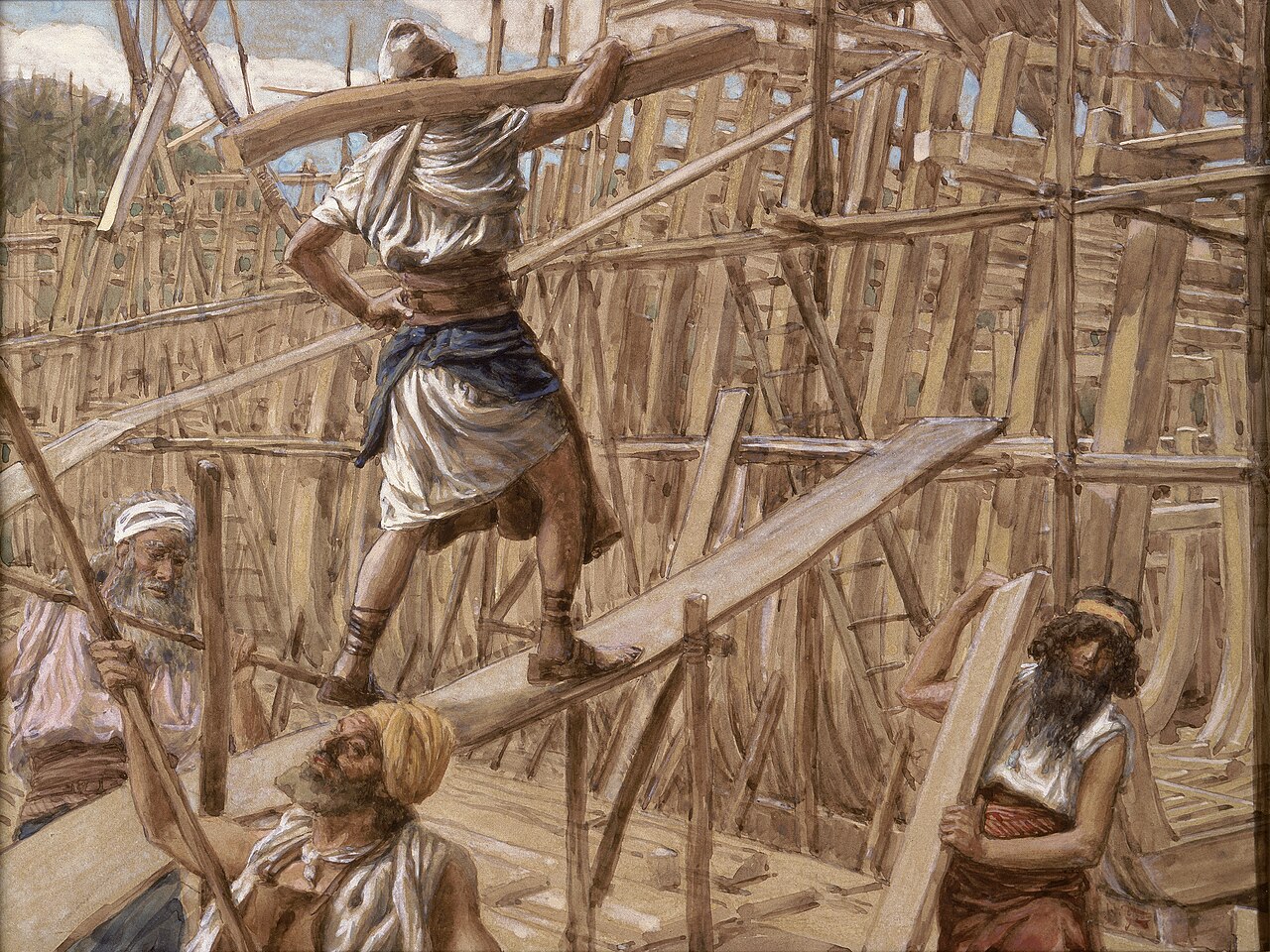
Painting: James Tissot, Building the Ark · Public domain · Wikimedia Commons
The wood here called “gopher” appears only once in the whole Bible, so its exact species is unknown; many take it to be a cypress-family conifer. The “pitch” (Hebrew kopher) applied inside and out for waterproofing comes from the verb kaphar, “to cover” — the very verb later used for “to make atonement.” This is, of course, a matter of the word’s texture rather than the text’s direct teaching; but it is striking how the picture of an ark that holds back the waters of judgment and “covers” life overlaps with the language of atonement.
The dimensions are remarkably concrete. Taking one cubit as about 45 cm, the ark measures about 135 m long, 22.5 m wide, and 13.5 m high — a huge box-like structure with proportions of 30:5:3. Those proportions are noteworthy even to modern naval engineering. In 1992-93, at the request of the Korea Association for Creation Research, a team led by Dr. Seok-Won Hong at the Korea Research Institute of Ships and Ocean Engineering (KRISO) tested a 1/50 scale model of the ark alongside comparison hull forms in a large towing tank, and concluded that the ark’s proportions are near-optimal in balancing structural safety, overturning stability, and seakeeping — able to endure sea states with waves over 30 m — publishing the results in a creation-science international journal (Creation Ex Nihilo Technical Journal, 1994). The ark had neither sail nor rudder. Its safety lay not in seamanship but in God’s design and God’s keeping.
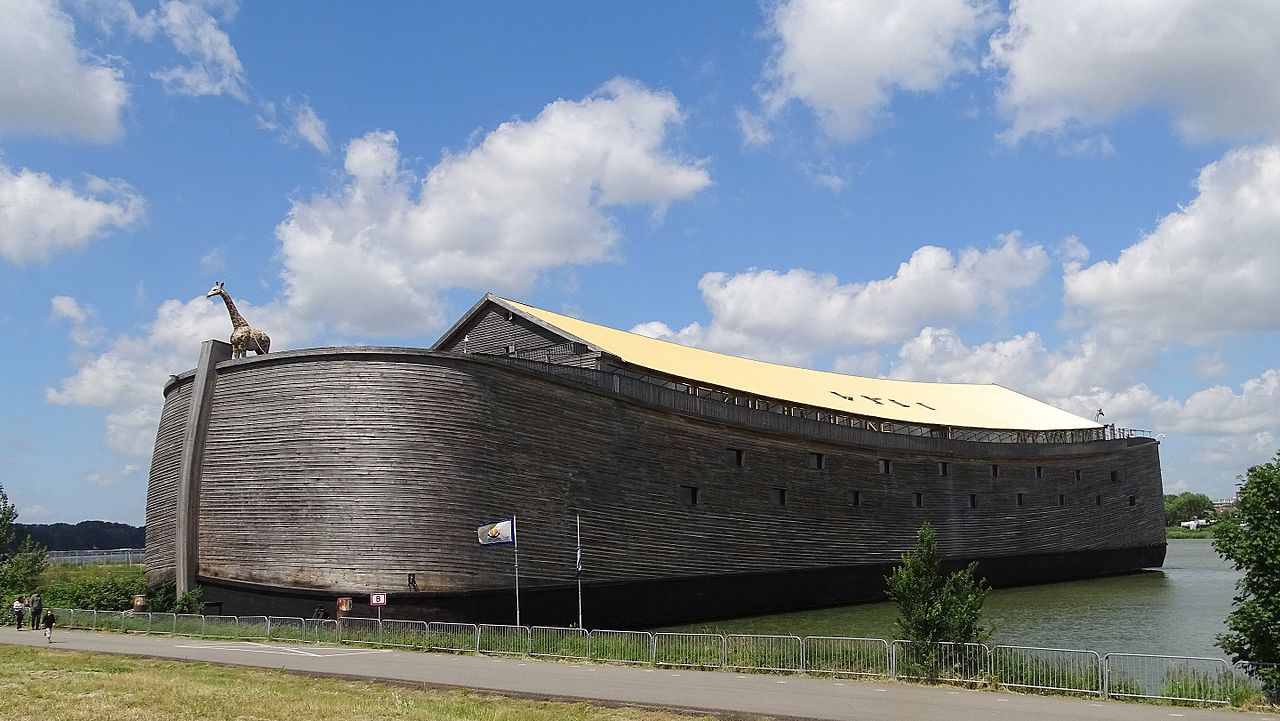
Photo: neufal54 · CC0 (public domain dedication) · Source: Wikimedia Commons
The First “Covenant” in the Bible (6:17-22)
“I, even I, do bring the flood of waters on this earth, to destroy all flesh having the breath of life from under the sky. Everything that is in the earth will die. But I will establish my covenant with you. You shall come into the ship, you, your sons, your wife, and your sons’ wives with you.”— Genesis 6:17-18 (WEB)
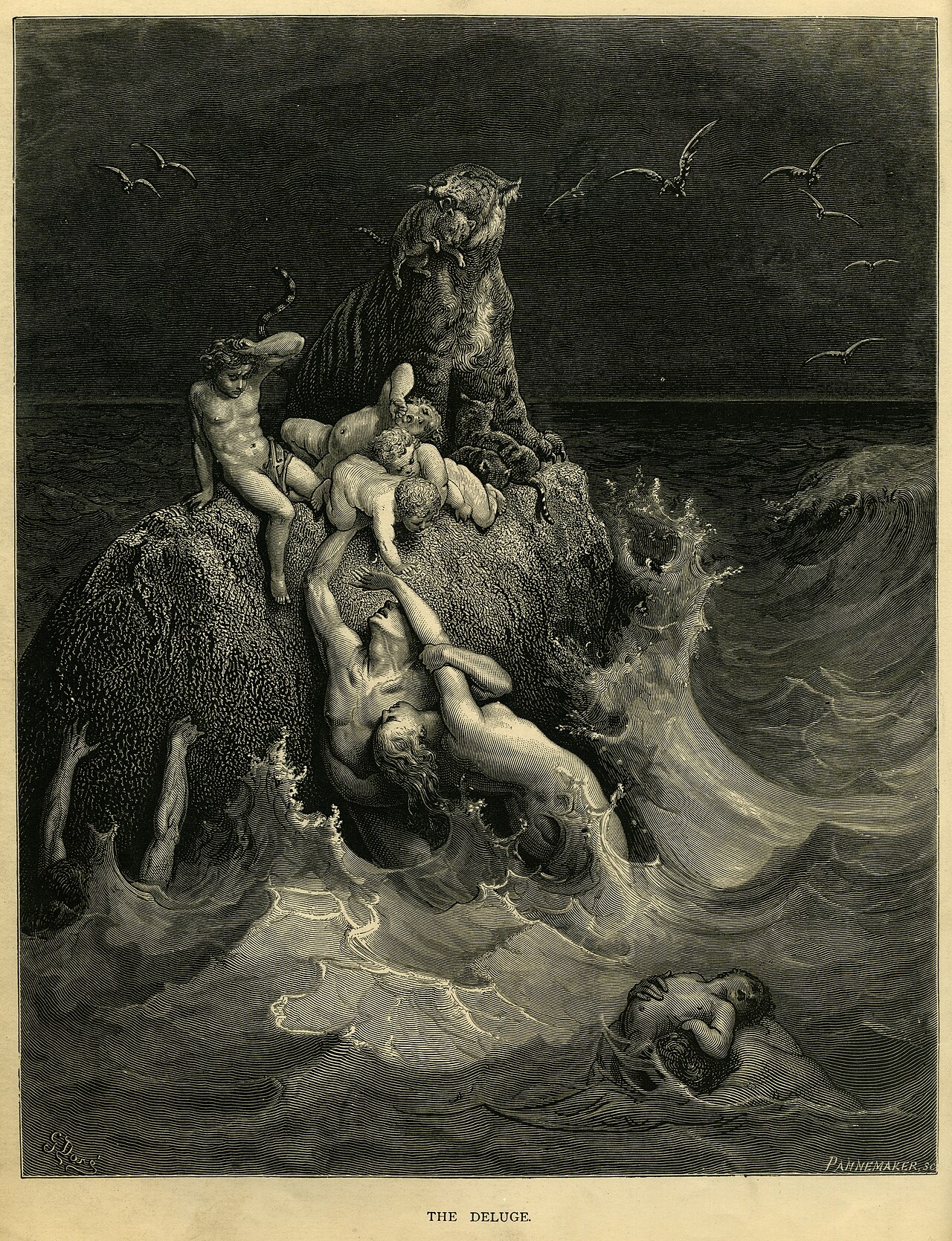
Engraving: Gustave Doré, The Deluge · Public domain · Wikimedia Commons
Here another first word of the Bible appears: “covenant” (Hebrew berith). The first appearance of this word — used two hundred eighty-four times in the Old Testament and destined to become the backbone of biblical theology — stands in the very middle of the announcement of the flood. The covenant with Abraham, the covenant at Sinai, and the “new covenant” of our Lord — their first thread begins with this promise to Noah: “But I will establish my covenant with you.” Like grace, covenant is a word of salvation born inside judgment.
Even the word “ark” carries Scripture’s fine grain. The Hebrew tebah occurs twenty-eight times in the Old Testament — every single one in the story of Noah’s ark (Genesis 6-9) and in the story of the basket that carried the infant Moses (Exodus 2:3-5). “She took a papyrus basket for him, and coated it with tar and with pitch” (Exodus 2:3) — the reed basket, too, was a pitch-coated tebah. A vessel of salvation that carries life through the waters of judgment and danger: Scripture lays the two rescues on top of each other with a single word.
“Of every living thing of all flesh, you shall bring two of every sort into the ship, to keep them alive with you. They shall be male and female. Of the birds after their kind, of the livestock after their kind, of every creeping thing of the ground after its kind, two of every sort will come to you, to keep them alive.”— Genesis 6:19-20 (WEB)
“Two of every sort will come to you” — even the gathering of the animals was not Noah’s skill but God’s leading. The hand of the God who preserves the life He created, “after their kind,” is written into the very plan of judgment. And the chapter closes with a single sentence.
“Thus Noah did. He did all that God commanded him.”— Genesis 6:22 (WEB)
No objections, nothing subtracted, nothing added — “all that God commanded.” The mark of a man who has received grace is this kind of simple, total obedience. For a man who had never seen such a ship or such rain to spend decades building a vessel — that is obedience explicable only by faith (Hebrews 11:7).
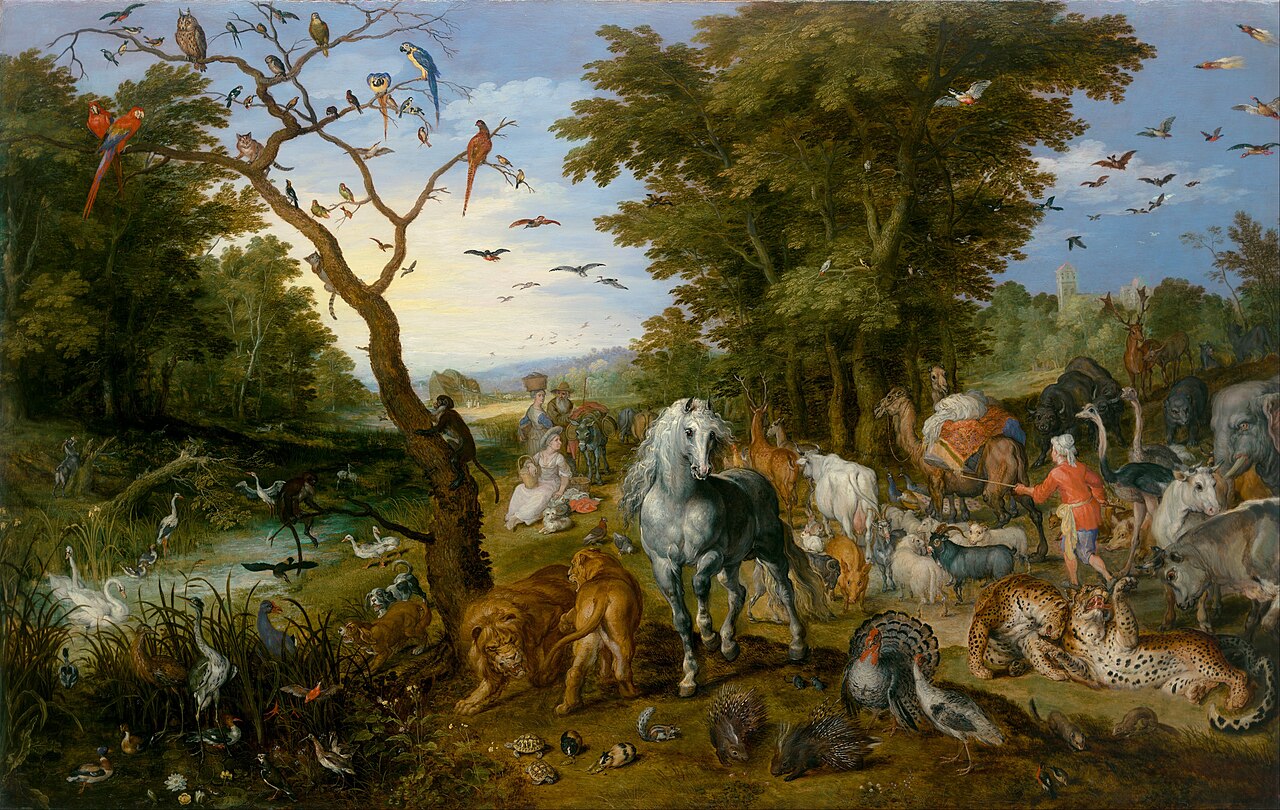
Painting: Jan Brueghel the Elder · Public domain · Wikimedia Commons
What the Ark Points To — From Noah to Christ
The New Testament reads Noah’s flood not as legend but as real history — and as a picture of salvation. Peter testifies:
“who before were disobedient, when God waited patiently in the days of Noah, while the ship was being built. In it, few, that is, eight souls, were saved through water.”— 1 Peter 3:20 (WEB)
Peter holds on to two things here. One is God’s patient waiting — the long years of building the ark were years of divine forbearance. The other is how few were saved — in all the world, only eight souls. Second Peter calls Noah “a preacher of righteousness” (2 Peter 2:5): the years of building were not years of silence but years of preaching. And it says that flood was a preview of the final judgment — “the world that then was, being overflowed with water, perished. But the heavens that now exist, and the earth, by the same word have been stored up for fire” (2 Peter 3:6-7). As the judgment by water was real, so the judgment to come is real. Yet on that day too the promise stands: “the Lord knows how to deliver the godly out of temptation” (2 Peter 2:9).
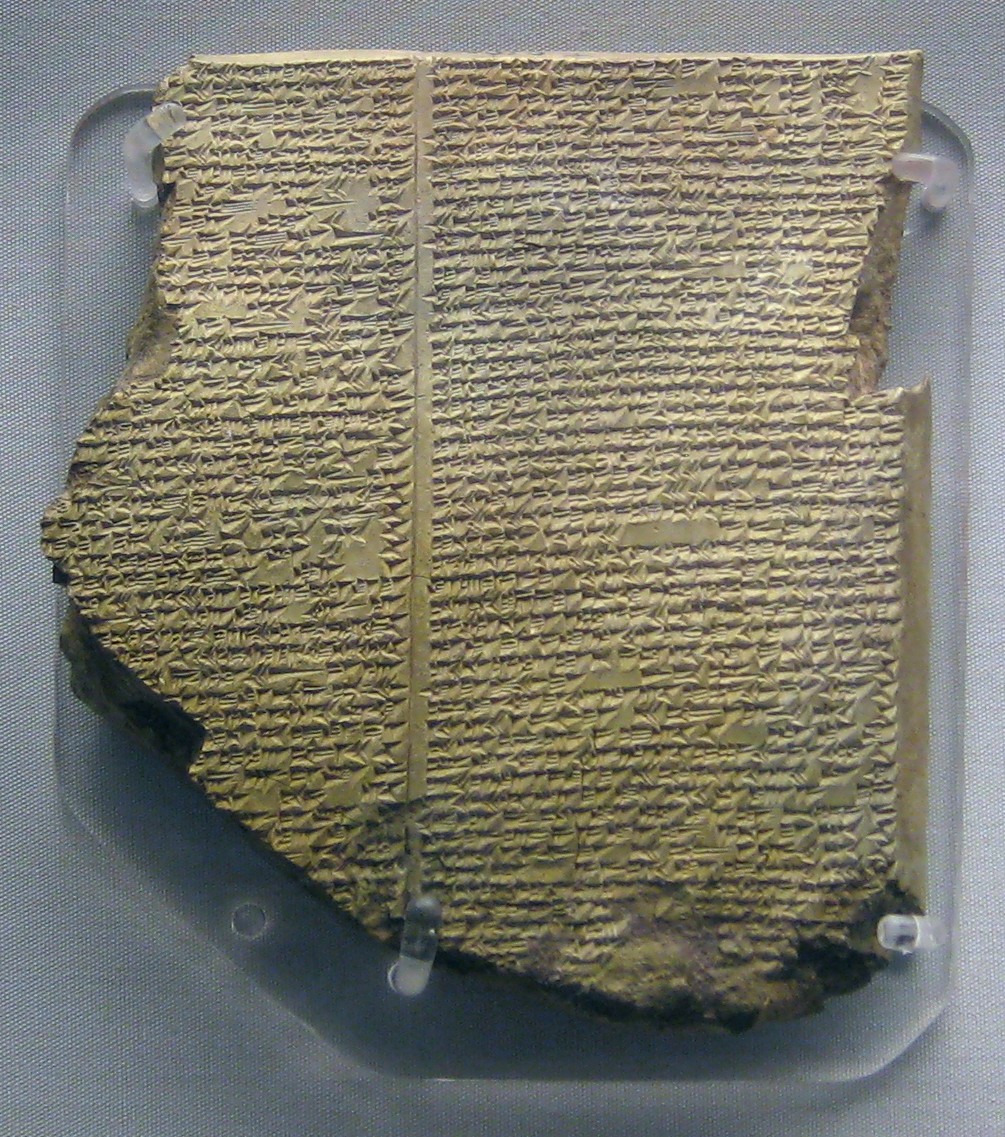
Photo: BabelStone · CC0 (public domain dedication) · Source: Wikimedia Commons
Interestingly, the memory of a great deluge survives outside the Bible as well. The British Museum holds the “Flood Tablet” — Tablet XI of the Epic of Gilgamesh, deciphered in 1872 by George Smith to worldwide astonishment — inscribed with the story of a man who built a boat and survived a flood. But beneath the similar surface, the two accounts inhabit opposite worlds. The flood of Gilgamesh springs from the caprice of a council of gods, and its boat is an easily-capsized cube; the flood of Genesis is the righteous judgment of the one holy God upon sin, its ark a vessel of rescue built to seaworthy proportions, and the story ends not with a survivor’s immortality but with God’s covenant. Above the flood memories spread across the ancient world, Genesis alone testifies to the true meaning of the event — the justice that judges and the grace that saves.
A Day Like the Days of Noah — Before the Door Closes
When Jesus spoke of His return, He pointed to no other era than the days of Noah.
“As the days of Noah were, so will be the coming of the Son of Man. For as in those days which were before the flood they were eating and drinking, marrying and giving in marriage, until the day that Noah entered into the ship, and they didn’t know until the flood came, and took them all away, so will be the coming of the Son of Man.”— Matthew 24:37-39 (WEB)
Eating and drinking, marrying and giving in marriage — these are not sins in themselves. The problem is “they didn’t know.” Buried in the everyday, they let God’s warning pass them by; that was the ruin of Noah’s generation, and Jesus says the last days will be the same (cf. Luke 17:26-27). So Genesis 6 leaves us with two questions today.
First, am I inside the ark? The ark had one door, and salvation belonged only to those who passed through it. “How narrow is the gate, and restricted is the way that leads to life! Few are those who find it” (Matthew 7:14). As Noah’s ark was then, so the way of salvation God has prepared is one person: Jesus Christ. The place where grace is found — in Him — is our ark.
Second, am I building and preaching like Noah? Having found grace, Noah did not quietly save himself. He was called “a preacher of righteousness” (2 Peter 2:5), and the sound of his hammer was itself a sermon to his generation. The task entrusted to us is the same. Before judgment comes, in the time of God’s patience, to carry the news of salvation — following the Lord’s command to make disciples of all nations (Matthew 28:19-20) — that is how we build the ark today, walking Noah’s path.
In the middle of a world full of wickedness, Scripture spoke of “grace” for the first time; in the very center of a declaration of judgment, it spoke of “covenant” for the first time. Genesis 6 asks us today: “Before the flood, while the door still stands open — where are you standing?”
References
- Genesis, Korean Revised Version (1961) — Wikisource (public-domain Bible text)
- Genesis 6 Interlinear — Bible Hub (Hebrew text with parallel gloss)
- חֵן (chen, “grace”) — Bible Hub Hebrew lexicon and concordance (Genesis 6:8 is the first occurrence)
- Hong, S.W. et al., “Safety Investigation of Noah’s Ark in a Seaway” — KRISO ark-stability study (1994)
- The Flood Tablet (Tablet XI, Epic of Gilgamesh) — British Museum / Google Arts & Culture
- How long did Noah build the ark, and how long was he aboard? — GotQuestions (Korean)
- Korean Bible Society — for the New Korean Revised Version and other licensed translations