
Have you ever looked down over a city skyline at night? Millions of tightly packed lights are at once a monument to human civilization and a strangely unsettling question. Harvard urban economist Edward Glaeser answers that question with striking clarity in Triumph of the City (2011): the city, he argues, is “our greatest invention,” making us richer, smarter, greener, healthier, and happier. How should a Christian read this hymn to the city? This essay rereads a bestseller of secular urban economics through the lens of faith, discerning both where it overlaps with Scripture and where the two roads part.
The English Scripture quotations here are from the King James Version and the World English Bible (both public domain).
A Harvard Economist Defends the City
Edward Glaeser is the Fred and Eleanor Glimp Professor of Economics at Harvard University and a leading authority in urban economics. With a bachelor’s degree from Princeton and a PhD in economics from the University of Chicago, he distilled years of empirical research into this single book. In Korea it was published by Haenaem, translated by Lee Jin-won (first edition 2011, revised edition 2021, 544 pages), and its subtitle sums up the whole argument: How Our Greatest Invention Makes Us Richer, Smarter, Greener, Healthier, and Happier.
Glaeser’s central thesis is simple and provocative: the genius of the city lies in “density.” When people are packed closely together, ideas spread faster, and this circulation of knowledge breeds innovation and prosperity. Silicon Valley and Bangalore grew this way. He overturns several pieces of conventional wisdom. First, he claims that cities are actually greener: dense urban dwellers rely less on cars and use far less energy than suburbanites. Second, slums are not failures but ladders of opportunity. The poor flock to places like Mumbai’s Dharavi not because the city makes them poor, but because the city offers better chances than the even harsher poverty of the countryside. Third, he strongly advocates “build up, not out”—high-rises and looser building regulations. And one sentence runs through all of it: “a city is its people, not its buildings.”

Photo: Don Ramey Logan · CC BY-SA 4.0 · via Wikimedia Commons
Where They Overlap: The Bible Does Not Abandon the City
Remarkably, Glaeser’s affirmation of the city resonates deeply with one strand of Scripture. Some believers regard the city only as a hotbed of sin and corruption, nursing a “back to nature” sentiment. Yet the Bible does not simply discard the city. On the contrary, to His people in Babylonian exile God gave a surprising command:
Build houses and dwell in them. Plant gardens and eat their fruit. … Seek the peace of the city where I have caused you to be carried away captive, and pray to Yahweh for it; for in its peace you will have peace. (Jeremiah 29:5, 7, WEB)
Neither flee the pagan city of your captivity nor be blindly absorbed into it, but settle, serve, and seek its peace (shalom). It is precisely this text—Jeremiah 29:7—that the pastor-theologian Tim Keller returned to again and again in his theology of the city. In Center Church, Keller names being “city-centered” as one of the core commitments of gospel ministry, viewing the city as “a wonderful, strategic, and yet underserved place for gospel work.” The insight that God’s concern gathers where people gather stands, unexpectedly, right alongside Glaeser’s “a city is its people.” If the essence of a city is not its buildings but its people, then what God treasures is, in the end, the people of that city.
What Scripture Saw First: The City’s Shadow—A Dimension Glaeser Misses
But the Bible’s vision of the city is far more dimensional than Glaeser’s optimism. Scripture affirms the city and, at the same time, honestly gazes at the shadow cast over its very roots. Consider who built the first city:
He built a city, and called the name of the city, after the name of his son, Enoch. (Genesis 4:17, WEB)
The one who founded the first city was Cain—the man who killed his brother and departed from the presence of God. Human anxiety and self-defense are inscribed in the city’s very origin. That shadow reaches its climax at the Tower of Babel.
And they said, Go to, let us build us a city and a tower, whose top may reach unto heaven; and let us make us a name, lest we be scattered abroad upon the face of the whole earth. (Genesis 11:4, KJV)
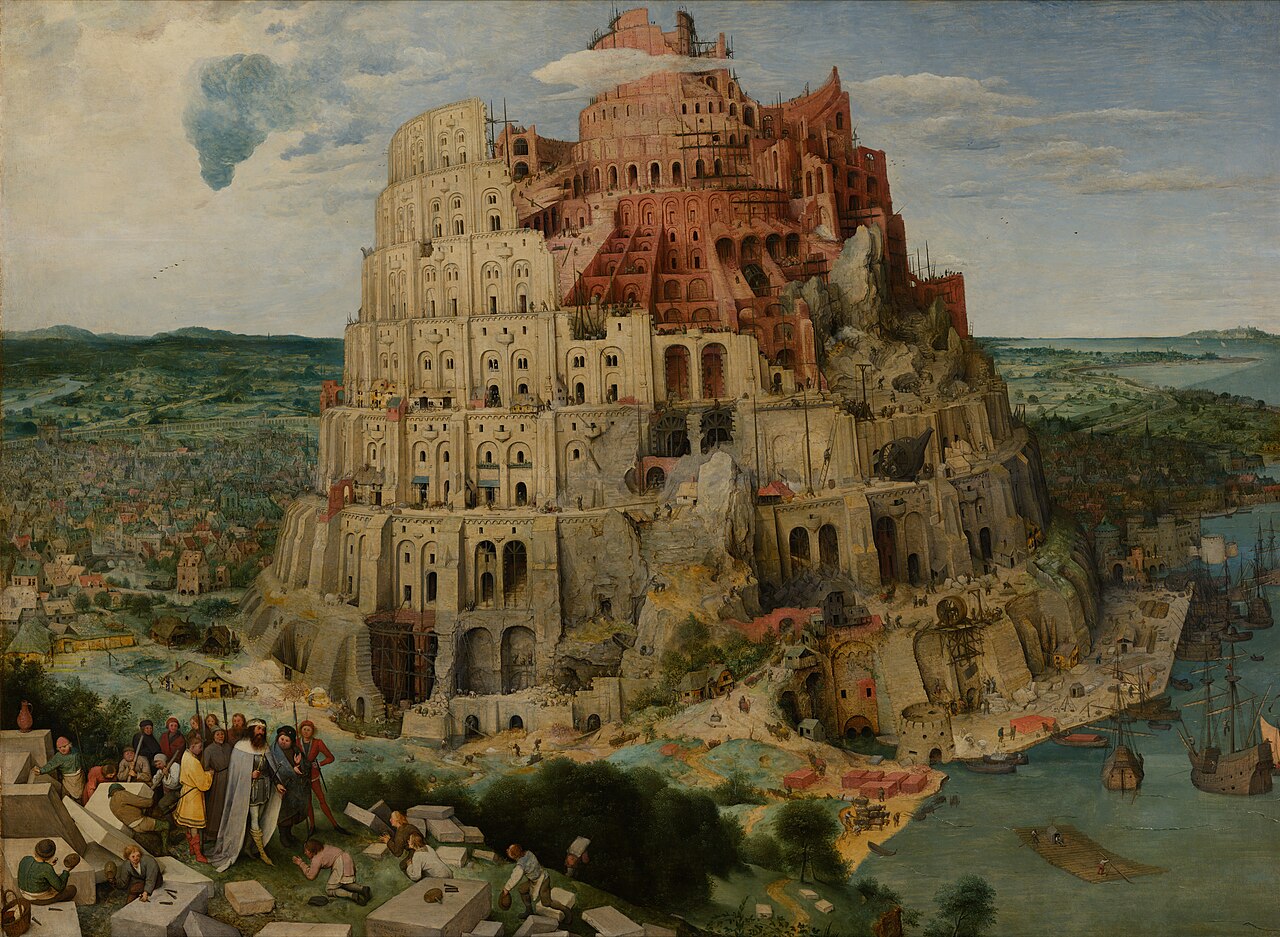
Painting: Pieter Bruegel the Elder, The Tower of Babel (1563) · Public domain · via Wikimedia Commons
Babel’s motive was to “make us a name“—the glory not of God but of humanity itself. The city became a monument to human greatness, and God judged it, confusing their language and scattering them (Genesis 11:8-9). Scripture traces this lineage of the self-glorifying city all the way to the end. In Revelation, the summit of human pride appears as “Babylon the great,” and at last it is judged: “Fallen, fallen is Babylon the great” (Revelation 18:2, WEB). When the fourth-century theologian Augustine, in The City of God, contrasted the earthly city (love of self) with the City of God (love of God), he was building on this very biblical insight.
Here a dimension Glaeser cannot reach comes into view. He paints the city as the pure triumph of human talent and cooperation, but Scripture knows that within the same density and achievement, the pride of making a name for oneself grows as well. Indeed, even secular reviewers note that Glaeser treats the harsh realities of urban poverty too lightly. The reductive optimism of remarks like “even the cashless can enjoy Ipanema beach” fails to hold the real suffering of those who groan in the slums. Scripture’s eye never forgets the city’s shadow—exploitation, alienation, loneliness—alongside its glory.
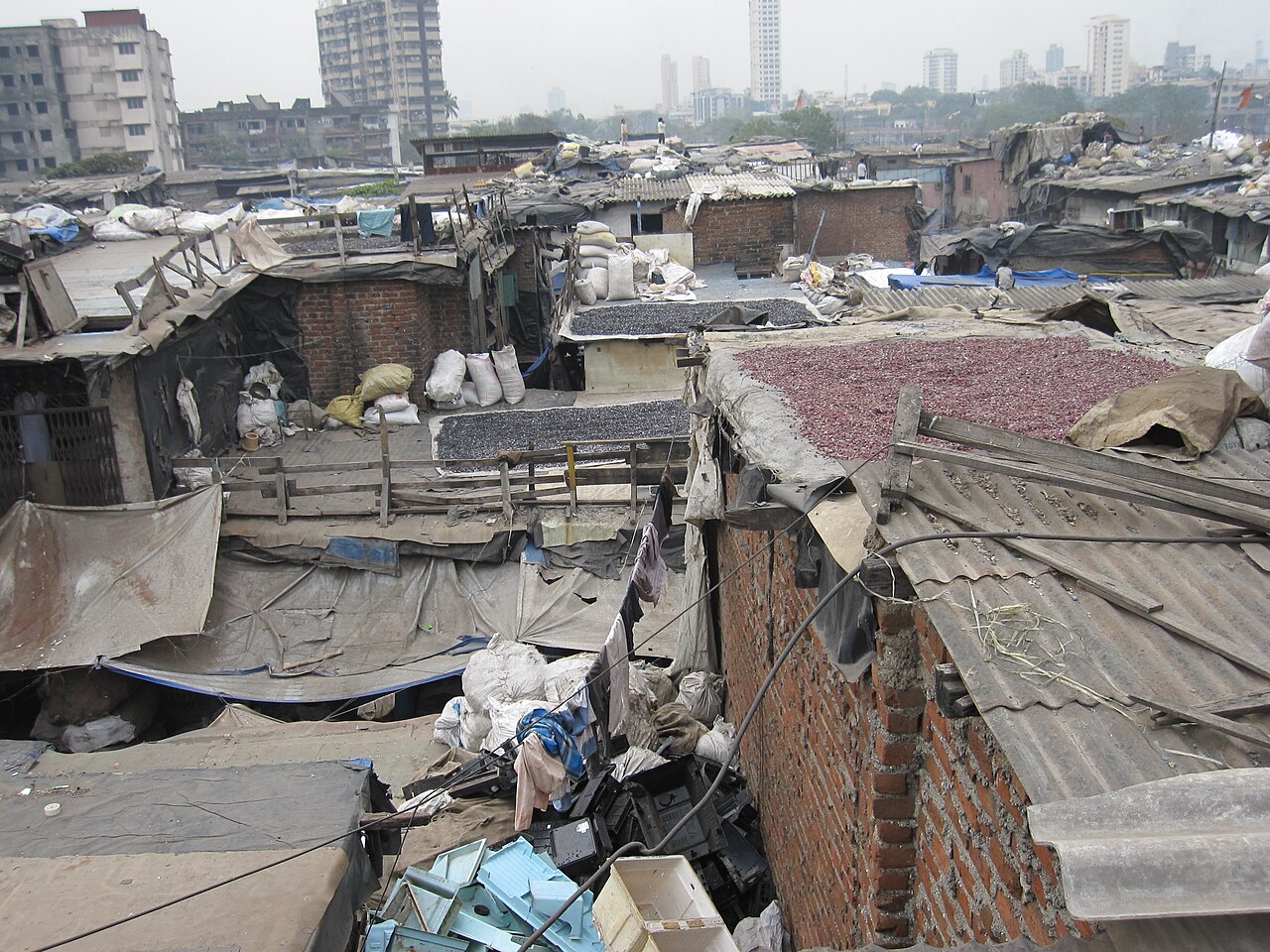
Photo: erin (Evanston) · CC BY 2.0 · via Wikimedia Commons
Where the Roads Part: A City Built Up, or a City Received?
This is where the book and the Bible diverge most sharply. For Glaeser, the city is humanity’s greatest invention, built up from below. The logic of Babel—the upward gesture of building “to reach heaven”—runs through his entire book. But the ultimate city Scripture presents comes from the opposite direction.
And I John saw the holy city, new Jerusalem, coming down from God out of heaven, prepared as a bride adorned for her husband. (Revelation 21:2, KJV)

Illustration · AI-generated (Codex/ChatGPT) — symbolic depiction
Babel is a city built up; the New Jerusalem is a city received. One is a human achievement; the other is a gift of God. This is the city the fathers of faith longed for as well: “For he looked for a city which hath foundations, whose builder and maker is God” (Hebrews 11:10, KJV). Instead of building a city for themselves, they yearned for the city whose architect is God: “God … hath prepared for them a city” (Hebrews 11:16, WEB). This contrast does not negate the city. Rather, Scripture says that the human story begins in a garden (Eden) and is completed in a city (the New Jerusalem). The city itself is not discarded but redeemed. Only, that city is not something we obtain by firing bricks and stacking them up, but something we receive by grace. If Glaeser’s city points to the summit of human ability, Scripture’s city points to the God who reaches out a hand beyond that summit. So the Christian loves the city without deifying it, and builds the city without building it to “make a name” for ourselves.
From the Place of the Great Commission: The City Is the Frontline Where All Nations Gather
The mission tgc.kr holds fast to is the Great Commission. “Go ye therefore, and teach all nations … Teaching them to observe all things whatsoever I have commanded you” (Matthew 28:19-20, KJV). But where are those “all nations” gathered today? In the cities. For the first time in human history, more than half the world’s population lives in cities. The “power of density” Glaeser documented is, in the language of mission, another way of saying that the city is the amplifier through which the gospel can spread most widely.
This is nothing new. The apostle Paul’s mission was city-centered from the start. He made strategic bases of the great cities of the empire—Athens, Corinth (a year and a half), Ephesus (two years)—and as a result it is recorded that “all those who lived in Asia heard the word of the Lord Jesus, both Jews and Greeks” (Acts 19:10, WEB). As Tim Keller put it, “Christian mission won the ancient Greco-Roman world by winning its cities.” To win the city was to win the whole region beyond it.

Photo: Nettadi · CC BY-SA 3.0 · via Wikimedia Commons
Yet urban mission is not merely a matter of statistics and strategy. Above all it begins with God’s heart for the city. Of the great city of Nineveh, God asked: “Shouldn’t I be concerned for Nineveh, that great city, in which are more than one hundred twenty thousand persons who can’t discern between their right hand and their left hand?” (Jonah 4:11, WEB). Jesus looked upon the city of Jerusalem and wept: “When he came near, he saw the city and wept over it” (Luke 19:41, WEB). Behind a city’s statistics are the faces God treasures, and tears for those faces. Glaeser “analyzes” the city; God “loves” the city and “weeps” over it. The starting point of urban mission is not data but those tears.
How Should We Read It—Discerningly, Yet Thankfully
Triumph of the City is not a book of Christian faith. God, sin, and redemption are absent from its vocabulary. Yet read through the lens of faith, this book becomes an excellent mirror, waking us to how shallowly we have understood the city. The urban vitality Glaeser observed—the creativity born of density, the civilization that flowers where people gather—is a set of fragments of the order God planted in creation. Only, the whole picture of those fragments—where the city comes from and where it is going—is found in Scripture.
I would recommend this book to the Christian who lives in a city and wrestles with the place of faith and life, to anyone who wants to grasp anew the calling of urban mission and the local church, and to anyone who needs practice in discerning secular social-science books through the eyes of faith. Read it holding two things in mind. First, the city is, before it is humanity’s triumph, the home of the people God treasures (Jonah 4:11). Second, the ultimate city we hope for is not a city built up but a city God sends down from heaven (Revelation 21:2). Then this book can serve to lead us—not into admirers of the city, but into disciples who love and serve the city and seek its peace (Jeremiah 29:7).
References
- Aladin — Triumph of the City (Korean revised edition), by Edward Glaeser, trans. Lee Jin-won, Haenaem, 2021 (bibliographic data and subtitle)
- Penguin Random House — Triumph of the City (full original title, subtitle, 2011 publication)
- Wikipedia — Triumph of the City (central thesis and structure)
- Scientific American — Triumph of the City (book excerpt) (the greener-city argument and energy-use comparison, from the original excerpt)
- National Civic League — Book Review: Triumph of the City (critique of urban poverty and economism)
- Tim Keller / Lausanne Movement — What Is God’s Global Urban Mission? (city-centered mission theology and the early church’s strategy)
- Redeemer City to City / Gospel in Life — Why God Made Cities (Tim Keller) (why God made cities and their redemption)
- Theology of Work — A Tale of Two Cities (Revelation 17–22) (Babylon vs. the New Jerusalem, the two-cities theology)