
The English Scripture quotations here are from the King James Version and the World English Bible (both public domain).
When the door of the ark was opened and Noah built an altar and offered burnt offerings, God said, “I will not again curse the ground any more for man’s sake” (Genesis 8:21, WEB). Genesis 9 picks up right where that word leaves off. The judgment is over, and the world begins again. Yet a careful reading of this chapter reveals something startling — what has been made new is the world, but not the man. Even so, God shares his blessing again with that very same man, and establishes a covenant that will never again be broken.
God blessed Noah and his sons, and said to them, “Be fruitful, multiply, and replenish the earth.” (Genesis 9:1, WEB)
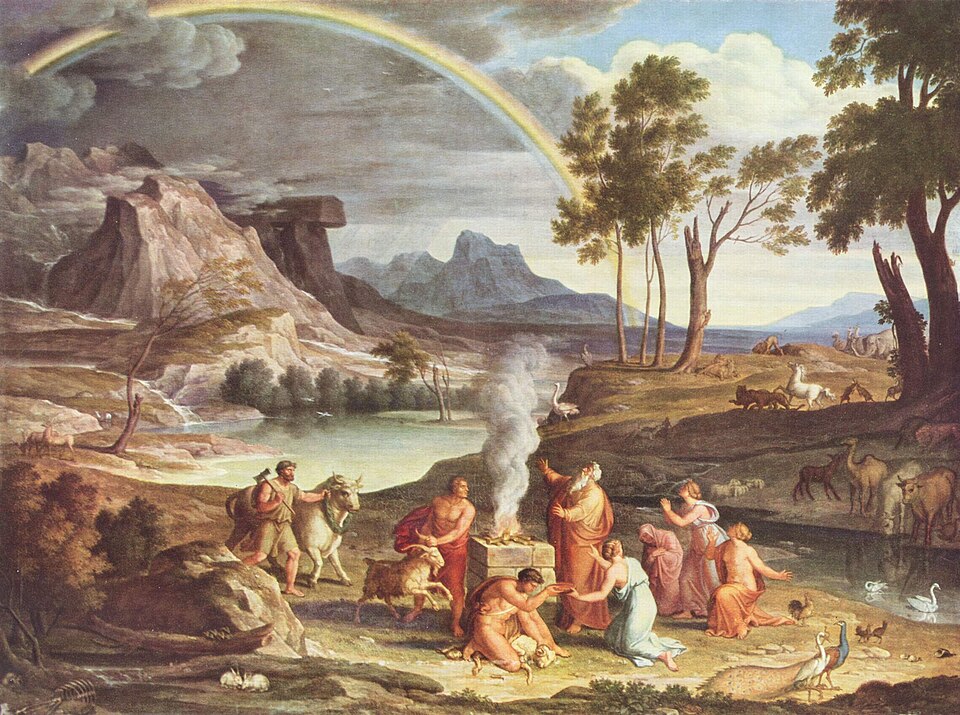
“Be Fruitful, Multiply, and Fill the Earth” — The Same Blessing, a Changed Rule (9:1-2)
God’s first words to Noah are the very same words he once spoke to Adam in Genesis 1.
God blessed them. God said to them, “Be fruitful, multiply, fill the earth, and subdue it. Have dominion over the fish of the sea, over the birds of the sky, and over every living thing that moves on the earth.” (Genesis 1:28, WEB)
The flood did not undo creation itself. Through Noah, God reaffirms the order he established at creation. Yet within these nearly identical words there is a clear change. In Genesis 1, humanity’s rule was given with no accompanying fear at all — now it is different.
The fear of you and the dread of you will be on every animal of the earth, and on every bird of the sky. Everything that moves along the ground, and all the fish of the sea, are delivered into your hand. (Genesis 9:2, WEB)

A relationship once ruled by love has become one held together by fear. This shows that humanity is no longer the innocent ruler it once was at creation. The world has been made new, but the fall has not been erased — and it is on top of that very sober reality that God gives his blessing all over again.
Meat and Blood — What Is Permitted and What Is Forbidden (9:3-4)
In Genesis 1, the only food given to man was plants and fruit.
God said, “Behold, I have given you every herb yielding seed, which is on the surface of all the earth, and every tree, which bears fruit yielding seed. It will be your food. (Genesis 1:29, WEB)
But Noah is given a new permission.
Every moving thing that lives will be food for you. As I gave you the green herb, I have given everything to you. But flesh with its life, that is, its blood, you shall not eat. (Genesis 9:3-4, WEB)
Eating meat is permitted, but a condition is attached — blood must not be eaten. This regulation does not end with Genesis 9. Leviticus later explains the reason.
For the life of the flesh is in the blood. I have given it to you on the altar to make atonement for your souls; for it is the blood that makes atonement by reason of the life. (Leviticus 17:11, WEB)
Blood is not merely one ingredient among others — it points to life itself. Deuteronomy 12:23 repeats the same principle, and in Acts 15:20, 29 the Jerusalem council reminds even the Gentile believers of this same regulation. This principle, set in place in the days of Noah, predates the Law of Moses and was still honored in the New Testament church — God’s will that life is not something for man to handle carelessly runs through the whole of Scripture.
“For God Made Man in His Own Image” — The Value of Life (9:5-7)
The regulation concerning blood leads directly into a regulation concerning human life.
And surely your blood of your lives will I require; at the hand of every beast will I require it, and at the hand of man; at the hand of every man’s brother will I require the life of man. Whoso sheddeth man’s blood, by man shall his blood be shed: for in the image of God made he man. (Genesis 9:5-6, KJV)

There is only one reason God requires life for the shedding of human blood: “for in the image of God made he man.” This basis reaches directly back to Genesis 1.
God created man in his own image. In God’s image he created him; male and female he created them. (Genesis 1:27, WEB)
Even after the fall, the image of God in man was not erased. And so the New Testament book of James issues, on that same logic, this warning.
With it we bless our God and Father, and with it we curse men who are made in the image of God. (James 3:9, WEB)
To harm another person is to trample the image of God stamped within them. The principle Genesis 9:6 establishes — that life is repaid with life — later carries into the authority of civil rulers spoken of in Romans 13:4 (“for he beareth not the sword in vain,” Romans 13:4, KJV), continually affirming that it is God alone who governs human life. Even after leaving this weighty word, God commands a blessing once more: “Be fruitful and multiply. Increase abundantly in the earth, and multiply in it” (Genesis 9:7, WEB). Even in a place still vivid with the memory of judgment, God’s final word is still blessing.
“I Have Set My Bow in the Cloud” — The Sign of an Everlasting Covenant (9:8-17)
This covenant does not come out of nowhere. Even before the flood began, God had already made this promise to Noah.
But I will establish my covenant with you. You shall come into the ship, you, your sons, your wife, and your sons’ wives with you. (Genesis 6:18, WEB)
Genesis 9 is where that promise is formally established. And yet this covenant is not limited to humanity alone.
“As for me, behold, I establish my covenant with you, and with your offspring after you, and with every living creature that is with you: the birds, the livestock, and every animal of the earth with you, of all that go out of the ship, even every animal of the earth. … I will establish my covenant with you: All flesh will not be cut off any more by the waters of the flood. There will never again be a flood to destroy the earth.” (Genesis 9:9-11, WEB)
This is a covenant God alone declares unilaterally, with no condition of human obedience or repentance attached. As its sign, the rainbow is given.
I do set my bow in the cloud, and it shall be for a token of a covenant between me and the earth. … And the bow shall be in the cloud; and I will look upon it, that I may remember the everlasting covenant between God and every living creature of all flesh that is upon the earth. (Genesis 9:13, 16, KJV)
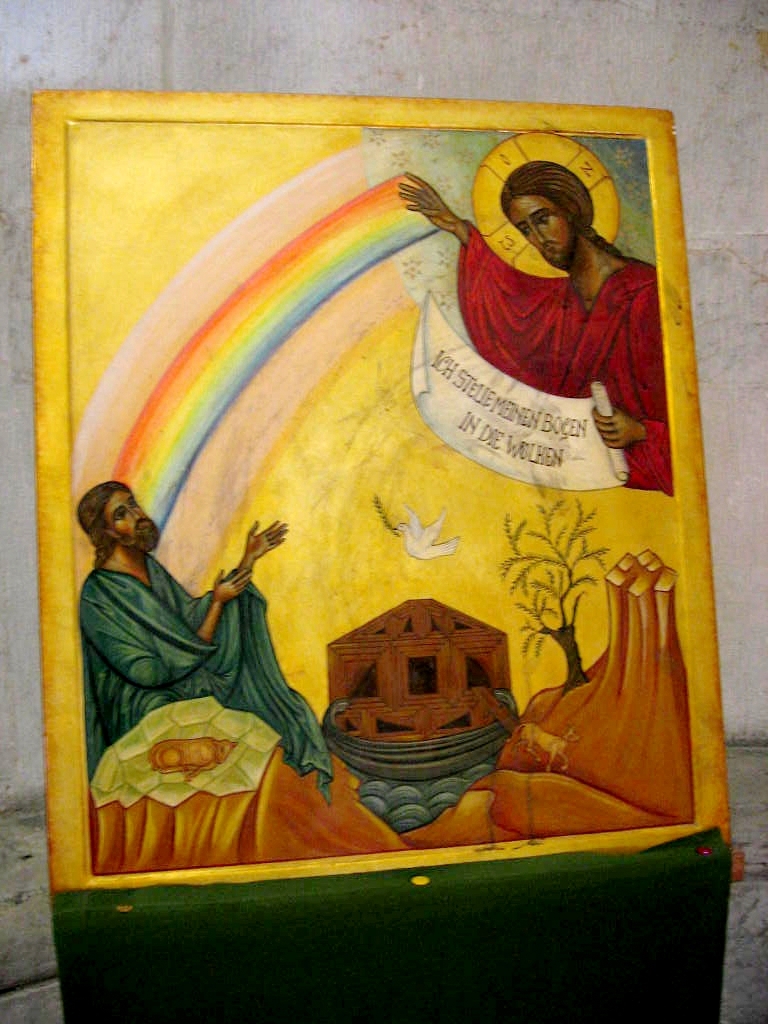
The Hebrew word for “rainbow” is the very same word used elsewhere in Scripture (for example, Habakkuk 3:9) for God’s judgment “bow.” A bow once used as a weapon of war now hangs in the clouds, no longer aimed at the earth. That the instrument of judgment itself becomes the sign of the covenant — this is the character of God that the Noahic covenant reveals.
In Noah’s Vineyard — Even the Saved Fall Again (9:18-23)
The very next scene after this everlasting covenant is proclaimed is, unexpectedly, the story of a man falling.
Noah began to be a farmer, and planted a vineyard. He drank of the wine and got drunk. He was uncovered within his tent. Ham, the father of Canaan, saw the nakedness of his father, and told his two brothers outside. Shem and Japheth took a garment, and laid it on both their shoulders, went in backwards, and covered the nakedness of their father. Their faces were backwards, and they didn’t see their father’s nakedness. (Genesis 9:20-23, WEB)
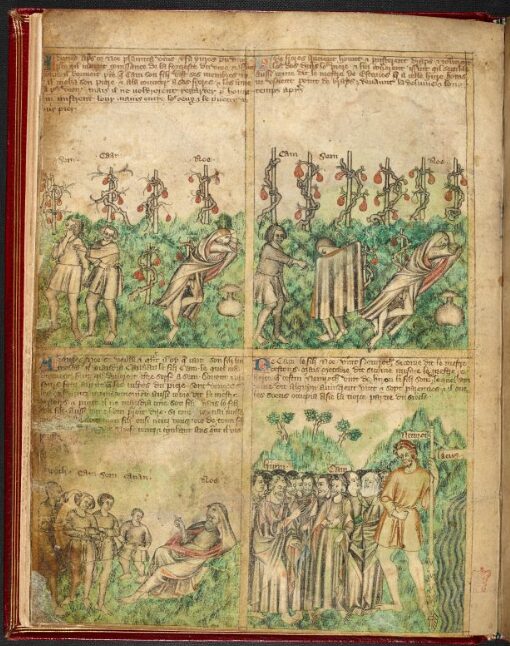
This scene sits alongside Genesis 3. In a cultivated place (a garden / a vineyard), after partaking of something (the forbidden fruit / wine), nakedness and shame follow — the exact same structure. Just as God himself made garments of skin to clothe Adam and Eve after they sinned (“Yahweh God made garments of animal skins for Adam and for his wife, and clothed them,” Genesis 3:21, WEB), so after Noah’s fall his sons Shem and Japheth turn their faces away and cover their father with a garment. Sin is exposed, but grace always covers.
Even though the flood had judged the sin of the whole earth, sin was still very much alive among the eight who came out of the ark. Being saved does not make a person perfect. Even Noah himself, standing at the very center of the covenant, was no exception.
The Prophecy of Curse and Blessing — Shem, Ham, Japheth, and the Nations to Come (9:24-29)
When Noah wakes from his wine and learns what has happened, he pronounces a prophecy.
He said, “Canaan is cursed. He will be a servant of servants to his brothers.” He said, “Blessed be Yahweh, the God of Shem. Let Canaan be his servant. May God enlarge Japheth. Let him dwell in the tents of Shem. Let Canaan be his servant.” (Genesis 9:25-27, WEB)
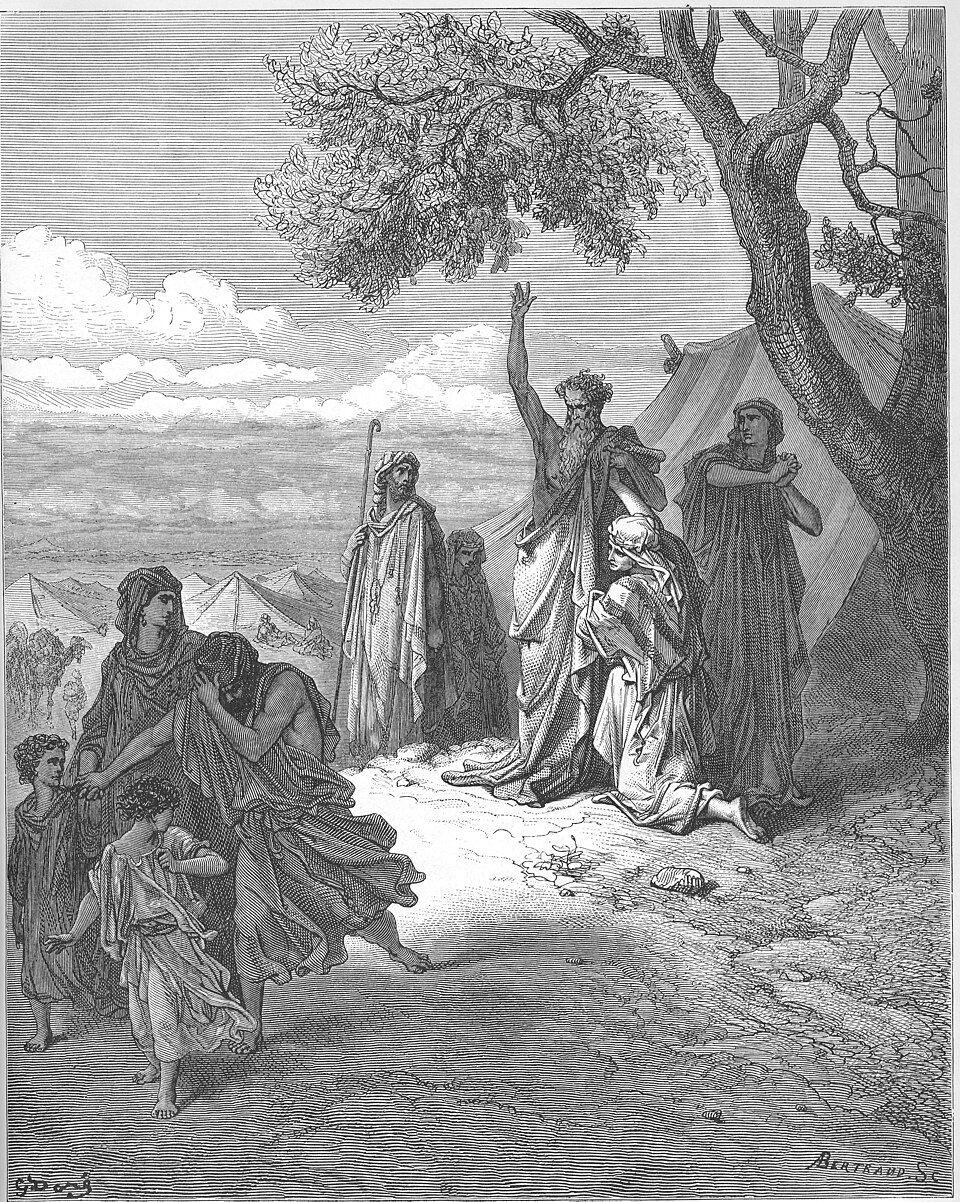
As the text plainly states, this curse falls not on Ham but is confined to “Canaan” alone and his line. It must not be stretched to cover Ham’s other sons, still less an entire race — the text must never be made to say what it does not say. This prophecy would go on to be fulfilled, in the time of Joshua, when part of the Canaanite peoples were brought in to serve the congregation of Israel (Joshua 9:27).
Shem, by contrast, is given the special title “Yahweh, the God of Shem,” and Japheth is granted to “dwell in the tents of Shem.” Shem’s line soon leads, in Genesis 11, to Abram (“All the families of the earth will be blessed through you,” Genesis 12:3, WEB), and this prophecy that Japheth would dwell in the tents of Shem has long been read as a foreshadowing that the Gentile nations would one day share in Shem’s blessing — the same trajectory Paul traces in Galatians 3:8-9, where Abraham’s blessing reaches the Gentiles, and in Ephesians 2:11-19, where Gentiles once far off are brought near by the blood of Christ and the dividing wall is torn down. From Noah’s three sons “the whole earth was populated” (Genesis 9:19, WEB), and after the flood Noah lived on for three hundred fifty more years before he died (9:28-29). From one family that had passed through judgment, the story of blessing for every family of the earth was already beginning to unfold.
The Weight of This Covenant across All of Scripture — A Blessing That Leads to Abraham
The Noahic covenant is not a story that appears once in Scripture and is then forgotten. Centuries later, Isaiah explains God’s faithfulness toward Israel by appealing to this very covenant.
“For this is like the waters of Noah to me; for as I have sworn that the waters of Noah will no more go over the earth, so I have sworn that I will not be angry with you, nor rebuke you. For the mountains may depart, and the hills be removed; but my loving kindness will not depart from you, and my covenant of peace will not be removed,” says Yahweh who has mercy on you. (Isaiah 54:9-10, WEB)
Even if the mountains are removed, this covenant will not be. The Noahic covenant is a universal covenant toward every living creature, while the Abrahamic covenant (Genesis 12, 15, 17) is a particular covenant that opens the history of redemption through one man and his offspring — different in scope, yet alike in that both rest not on human obedience but on God’s own faithfulness. Even so, this covenant’s promise that judgment will “never again” come by water does not mean judgment itself is gone forever. 2 Peter 3:5-7 sets the water-judgment of Noah’s day alongside a coming judgment by fire, making clear that God’s faithfulness does not abolish judgment — it determines its manner and its time.
For Us Today — The Covenant Never Changes, Though We Fall Again
Genesis 9 shows us two things at once. Even the man who came out of the ark, even the man who received the rainbow as the sign of the covenant, still falls — and yet God’s covenant with that very man does not waver. Being saved by grace does not turn us into people who no longer fall. But our weakness cannot undo God’s faithfulness.

God’s prophecy that Japheth would come to dwell in the tents of Shem ultimately extends all the way to every people being called, in Christ, to become God’s own. The command given to Noah, “Be fruitful, and multiply, and replenish the earth,” carries forward for us today into the words, “Go ye therefore, and teach all nations, baptizing them in the name of the Father, and of the Son, and of the Holy Ghost” (Matthew 28:19, KJV). A rainbow in the sky does not make us perfect — but because the God who set it there is faithful, we can rise again today from wherever we have fallen and carry forward the gospel he has entrusted to us.
In the original Korean edition of this article, Scripture quotations follow the public-domain Korean Revised Version (KRV, 1961); the English quotations above are from the King James Version and the World English Bible (both public domain).
References
- “Genesis 9: The Covenant of the Rainbow”, Bible Hub
- “What are the covenants in the Bible?”, GotQuestions
- “Why did Noah curse Canaan instead of Ham?”, GotQuestions
- “Damn the Curse of Ham: How Genesis 9 Got Twisted into Racist Propaganda”, The Gospel Coalition
- Full text of the Korean Revised Version Bible (Korean), Wikisource (Korean)
- Genesis 9, Korean Revised Version (KRV) text, YouVersion Bible.com
- Isaiah 54, Korean Revised Version (KRV) text, YouVersion Bible.com
- Korean Bible Society copyright information, bskorea.or.kr