
What if you woke up alone, the two people beside you already dead, unable to remember even why you were there? And what if that “there” turned out to be orbit around a strange star twelve light-years from Earth, with the survival of all humanity resting on your shoulders? Andy Weir’s science-fiction novel Project Hail Mary (2021) begins with exactly this question. Reading a secular bestselling SF novel through the eyes of faith may feel like an unusual exercise. Yet the themes this book confronts head-on — self-sacrifice, solidarity with a stranger, hope amid despair — are themes Scripture has held onto for far longer. This review sets out to trace where the two overlap, and where they part ways.

Photo: NASA/SDO (AIA) · Public domain · Source: Wikimedia Commons
The Last Mission Andy Weir Wrote — Author and Plot
Andy Weir wasn’t originally a novelist — he was a programmer. In the late 1980s, as a teenager, he began programming as an intern at Sandia National Laboratories, and went on to work as a software engineer for the next twenty-five years. At one point he even funded his writing by selling stock options he received after being laid off from America Online (AOL). Then, starting in 2009, a science-fiction novel he had been serializing on his own website as a hobby went viral, and his life changed. That novel was The Martian, and its success led Weir to leave programming behind and become a full-time writer. He carries his engineer’s mindset directly into his craft, once saying that “writing code and writing a book are both about breaking something big into smaller pieces.”
Where The Martian was the survival story of one man, Mark Watney, stranded alone on Mars, this novel is a different animal from the start. Unlike The Martian, it is, in fact, thoroughly not a solo story. The protagonist, Ryland Grace, wakes up aboard the spaceship Hail Mary with his memory gone. The two crewmates who traveled with him are already dead. As his memory slowly returns, he realizes why he is there: a microbe called Astrophage, which feeds on solar energy, has been rapidly dimming Earth’s sun and other nearby stars — and, strangely, only the Tau Ceti star system has proven resistant to the infection. Grace is the scientist sent — against his own will, in effect — on a mission with virtually no hope of return, tasked with discovering why and finding a clue that might save humanity. As the story unfolds, he meets Rocky, an alien engineer from the 40 Eridani system, and the two beings — utterly different in species, language, and body — become partners in the search for an answer. (This review does not cover the ending.) The Korean edition, translated by Kang Dong-hyeok, was published by RHK Korea in May 2021, simultaneously with the original.

Photo: Gage Skidmore · CC BY-SA 3.0 · Source: Wikimedia Commons
Where the Insights Overlap — Self-Sacrifice and Solidarity with a Stranger
The first place this novel touches a Christian reader is in the weight of the sacrifice Grace carries. He did not take on this mission because he wanted to be a hero. In an unfamiliar darkness, with no certain way home, he wagers what remains of his life for people he may never see again. Scripture has already given this kind of love a name.
The English Scripture quotations here are from the King James Version and the World English Bible (both public domain).
Greater love hath no man than this, that a man lay down his life for his friends. (John 15:13, KJV)
Of course, Grace’s sacrifice and Christ’s self-emptying belong to entirely different orders. Yet the trajectory Philippians describes — voluntarily setting aside a place of comfort, descending into obscurity, taking the form of a servant — overlaps strikingly with the moment this novel renders with its greatest emotional force.
who, existing in the form of God, didn’t consider equality with God a thing to be grasped, but emptied himself, taking the form of a servant, being made in the likeness of men. And being found in human form, he humbled himself, becoming obedient to the point of death, yes, the death of the cross. (Philippians 2:6-8, WEB)
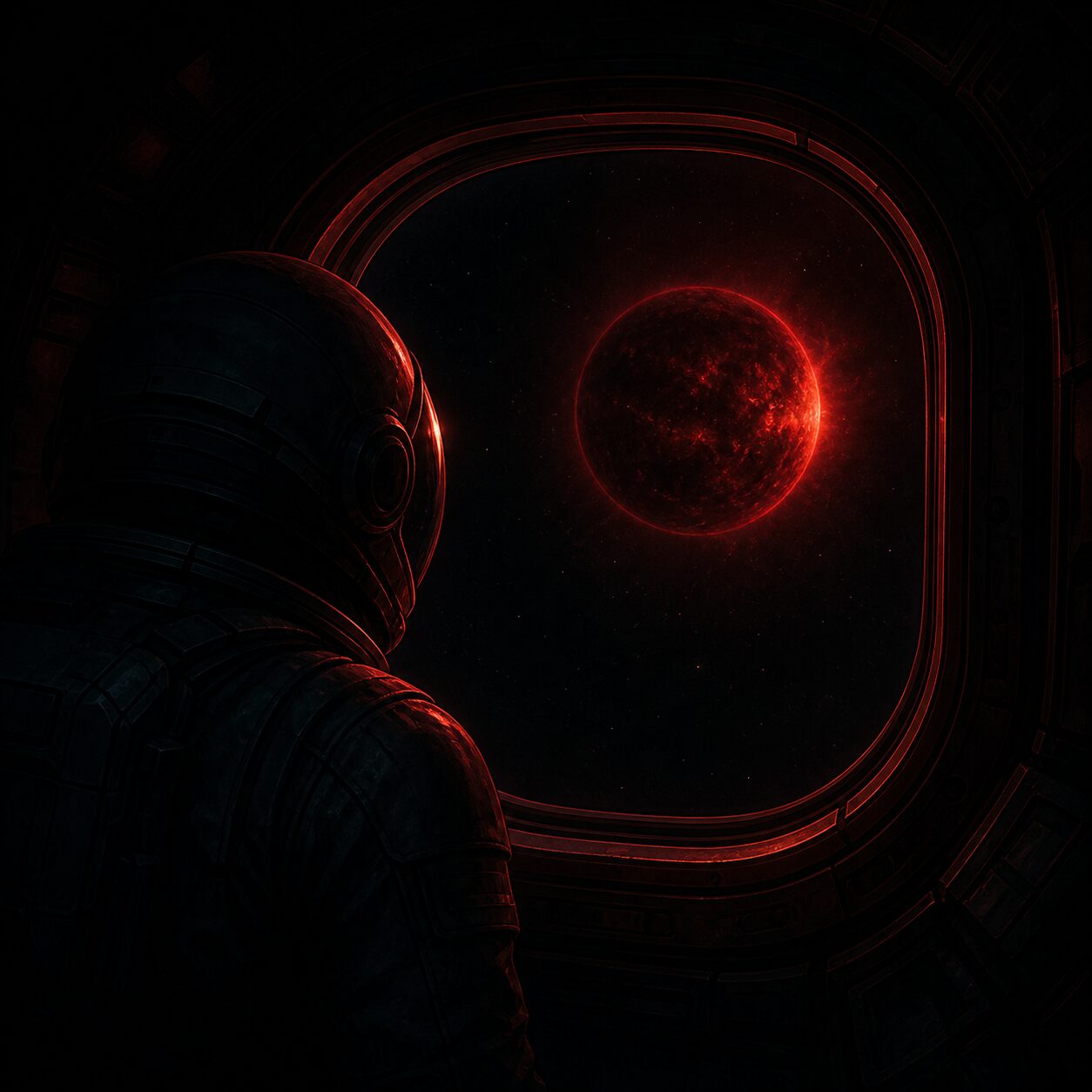
Illustration · AI-generated (Codex/ChatGPT)
The second overlap is the relationship with Rocky. Grace and Rocky are utterly different beings — biologically, in how they think, even in the senses they use to perceive the world. At first, they cannot even understand each other’s speech. Even so, the two learn to move past fear and cooperate, and that cooperation becomes the force that drives the story forward. Scripture holds a scene not unlike this one. Peter had spent his whole life learning that a Jew must not associate with a Gentile, yet God commands him to go to the house of Cornelius — a man Peter had regarded as belonging to an entirely different, unclean category.
You yourselves know how it is an unlawful thing for a man who is a Jew to join himself or come to one of another nation, but God has shown me that I shouldn’t call any man unholy or unclean. (Acts 10:28, WEB)
Paul declares this principle even more broadly.
There is neither Jew nor Greek, there is neither slave nor free man, there is neither male nor female; for you are all one in Christ Jesus. (Galatians 3:28, WEB)
Of course, the basis for solidarity in the novel and the basis for unity in Scripture are not the same. What binds Grace and Rocky together is a shared crisis and mutual respect, while what makes Jew and Greek one in Christ is the dividing wall torn down by the cross (Eph. 2:14). Still, the story’s core sentiment — that even utterly different beings can work together — makes for a beautiful enough analogy to bring to mind the truth that the gospel transcends every boundary humanity has built.

Illustration · AI-generated (Codex/ChatGPT)
The Weight of Mission Scripture Saw First — A Surface Resemblance to the Great Commission
The novel’s very narrative structure is worth noting. A person (or persons) is sent to an unknown, unfamiliar place, and only by completing the mission entrusted to them there does humanity — or the wider world — survive. On the surface, this resembles the sending structure of the Great Commission that tgc.kr holds onto.
All power is given unto me in heaven and in earth. Go ye therefore, and teach all nations, baptizing them in the name of the Father, and of the Son, and of the Holy Ghost: Teaching them to observe all things whatsoever I have commanded you: and, lo, I am with you alway, even unto the end of the world. Amen. (Matthew 28:18-20, KJV)
What stands out is the final line. As Jesus sends His disciples into unfamiliar territory, He promises, “I am with you always.” Grace had to shoulder that burden entirely alone — especially before he met Rocky — but the disciples who received the Great Commission had someone with them from the very start. This difference is not a small one.
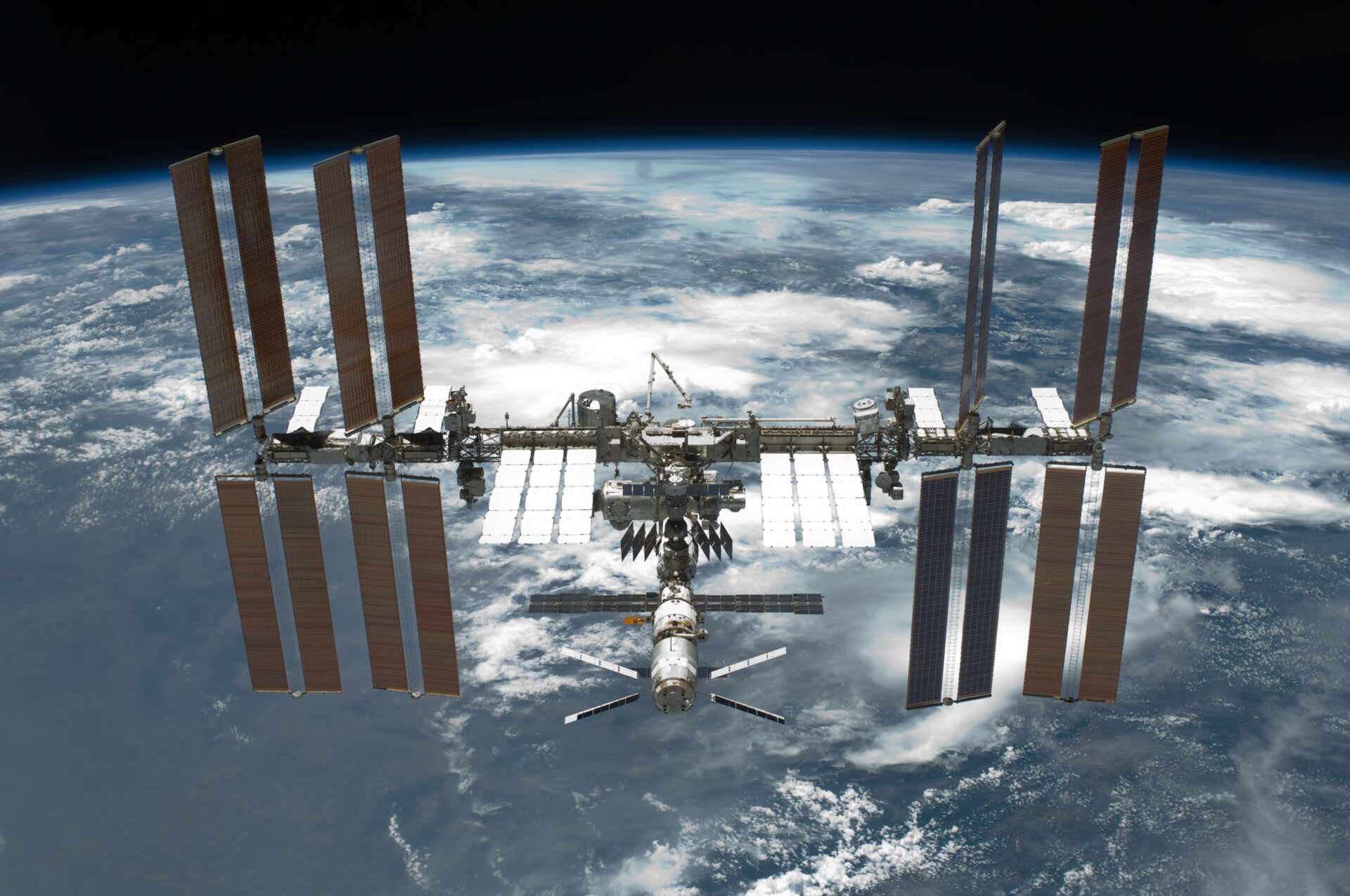
Photo: NASA (STS-134) · Public domain · Source: Wikimedia Commons
Where the Paths Diverge — Heroic Sacrifice Is Not the Same as Christ’s Atonement
Here, discernment is needed. Grace’s sacrifice is noble, but it remains, at bottom, the sacrifice of a human hero solving a problem of physical survival through science and engineering. Christ’s cross, by contrast, is a once-for-all event that cannot be repeated, resolving the problem of sin itself.
…but now once at the end of the ages, he has been revealed to put away sin by the sacrifice of himself. (Hebrews 9:26, WEB)
The word “once” is the key. Grace’s story is moving fiction, a narrative structure that could always be rewritten with a different crisis, a different hero, a different sacrifice (indeed, the entire science-fiction genre has repeated this narrative countless times). Christ’s sacrifice, however, is a finished event that needs no repetition and no supplement. It is true that this novel is moving, but that emotional impact must not be mistaken for salvation itself. The novel asks, “Can humanity overcome crisis through its own wisdom and courage?” Scripture answers, “Because we cannot solve the problem of our own sin, Christ solved it in our place.” The two questions operate on entirely different levels.
Illustration · AI-generated (Codex/ChatGPT)
A Literary Assessment — The Rigor of Hard SF and a Divided Critical Reception
Setting the faith-based reading aside for a moment and judging the book purely on its craft, Project Hail Mary is a solid work of hard science fiction. Weir researched the details of orbital mechanics, chemistry, and microbiology meticulously to build a finely engineered, problem-solving plot, and the way he constructed Rocky’s language and thought system in particular drew broad critical praise. Kirkus Reviews called it “a science-fiction masterwork,” and the novel won Best Science Fiction Novel at the 2021 Dragon Awards and was a finalist for the 2022 Hugo Award for Best Novel (the winner that year was Arkady Martine’s A Desolation Called Peace).
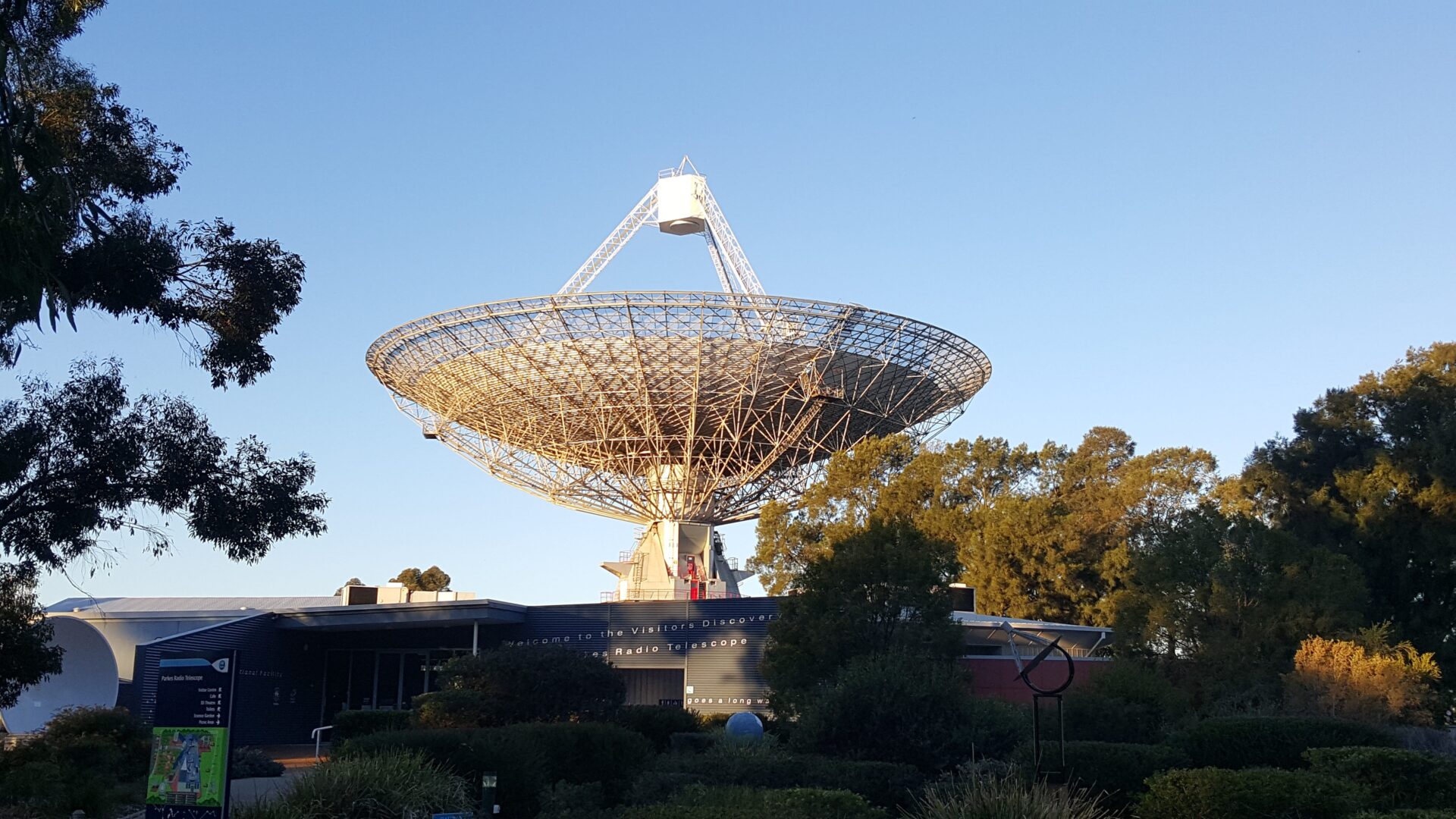
Photo: D0a5l0e6 · CC BY-SA 4.0 · Source: Wikimedia Commons
Not every assessment agrees, however. The New York Times Book Review (Alec Nevala-Lee) criticized Weir’s signature humor as feeling as formulaic as “jokes churned out by an algorithm raised on nothing but Joss Whedon scripts,” and The Washington Post (Mary Robinette Kowal) noted that a good deal of the narrative seems devoted to showing off the protagonist’s cleverness — cleverness that can end up becoming the novel’s own weakness. This is a point that can read as a strength to readers who enjoy the pleasure of scientific problem-solving, and as a shortcoming to readers looking for emotional depth.
How to Read It — Who Should Pick This Up
This book is recommended for readers who enjoy the scientific detail characteristic of hard SF, and for readers drawn to the question, “What would I give my life for?” For young-adult ministries or discipleship small groups discussing calling and commitment in particular, simply discussing together where Grace’s sacrifice overlaps with Christ’s atonement — and where the two part ways — can become a meaningful time of sharing. Even so, it should be remembered that this is not a book of faith but a thoroughly secular science-fiction novel. Enjoy the emotional impact the novel offers on its own terms, but leave the place it cannot point to — the forgiveness of sin and the hope of the resurrection — as Scripture’s to fill.
References
- Project Hail Mary — Wikipedia
- Project Hail Mary — Aladin (Korean edition bibliographic information)
- Sandia National Laboratories — Andy Weir interview
- Penguin Random House — Andy Weir author profile
- Kirkus Reviews — Project Hail Mary review
- Locus Online — 2021 Dragon Awards winners announcement
- The Hugo Awards — 2022 finalists list
- LitHub — 2022 Hugo Awards winners announcement
- Bookmarks — Project Hail Mary critical reception roundup
- John 15:13, Korean Revised Version (개역한글) — Bible.com
- Philippians 2:6-8, Korean Revised Version (개역한글) — Bible.com
- Acts 10:28, Korean Revised Version (개역한글) — Bible.com
- Galatians 3:28, Korean Revised Version (개역한글) — Bible.com
- Matthew 28:18-20, Korean Revised Version (개역한글) — Bible.com
- Hebrews 9:26-28, Korean Revised Version (개역한글) — Bible.com